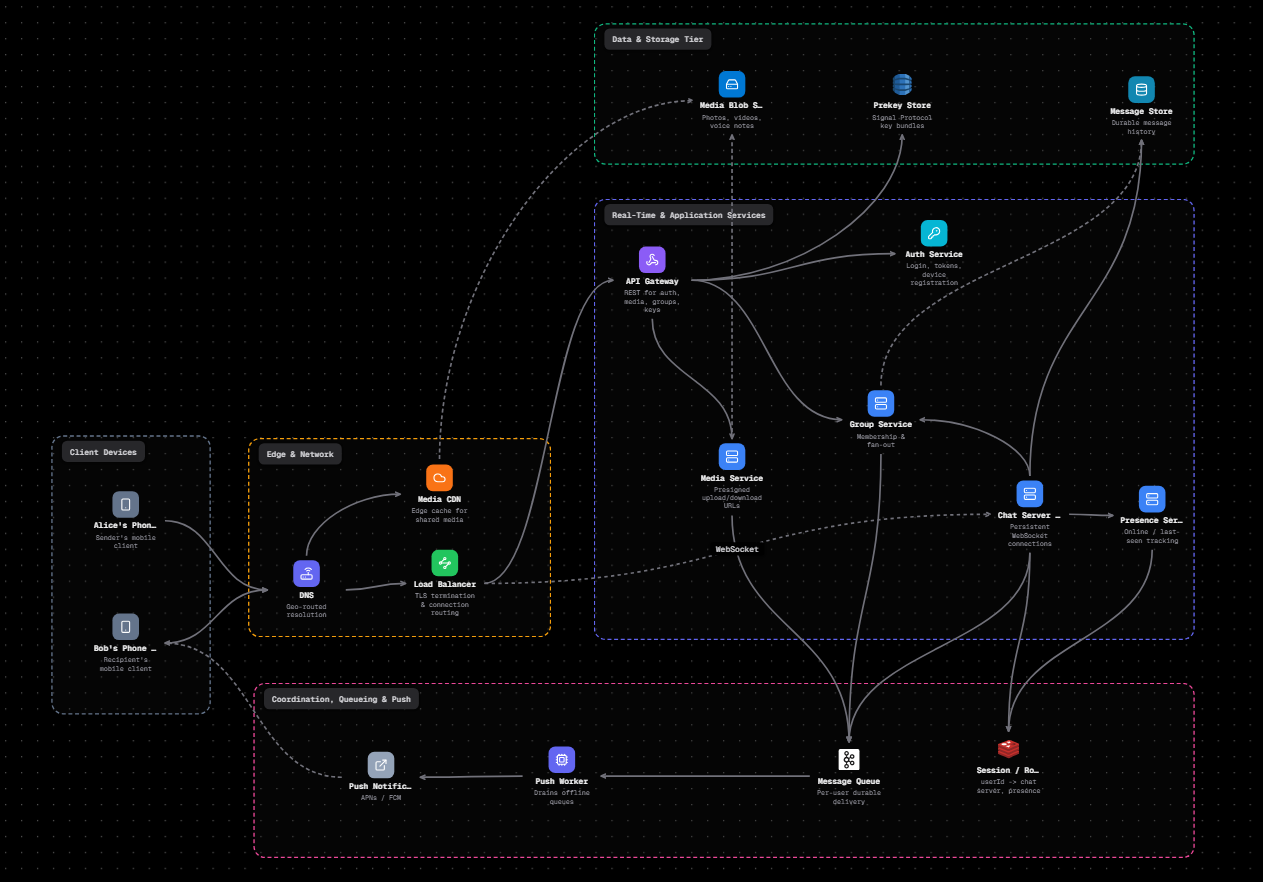
Design WhatsApp / Facebook Messenger
A real-time messaging platform with 1:1 and group chat, offline delivery via push notifications, and end-to-end encryption.


A cloud-based file storage and sync service supporting multi-device uploads, downloads, sharing, and real-time sync with chunked uploads, CDN delivery, and delta sync.
Denser dots = higher throughput. Hover any edge for its full contract.
Rough, order-of-magnitude numbers. The point is to justify the architecture, not to be exact.
No system is born with queues and caches. Every box was added because something was about to break. Play a stage and the diagram above shrinks to what existed at that point in the story.
The simplest version: a client discovers the service via DNS, authenticates through an API Gateway and Auth Service, and uploads/downloads files through the File Service — which generates presigned URLs so file bytes flow directly to and from object storage.
Metadata (file name, size, fingerprint) is persisted in a DynamoDB table keyed by userId. This works for thousands of users, but every download comes from a single regional bucket — latency is high for global users and origin egress costs grow linearly.
Scale pressure: Users far from the origin region wait 200ms+ for every download, and origin egress costs dominate the infrastructure budget
A CDN now fronts object storage for downloads: DNS geo-routes to the nearest edge, and cache hits serve in <20ms. Signed URLs with short expiration (5 minutes) enforce access control at the edge.
The CDN also supports Range requests so interrupted downloads resume without restarting — critical for mobile networks. Popular files are cached globally; the long tail still streams from origin.
Scale pressure: Users with multiple devices expect file edits on their laptop to appear on their phone within seconds — polling is too slow and too expensive at 100M DAU
A Sync Service maintains WebSocket connections per device for near-real-time push. When a file changes, the File Service publishes a file.changes event to a Kafka event bus. The Notification Worker consumes the event and pushes a sync notification through the WebSocket Manager to all of the user's online devices.
A Shared Files Cache (Redis) sits in front of the metadata DB to accelerate ACL lookups for frequently shared files. Offline devices get changes via periodic polling (GET /files/changes?since=...) when they reconnect.
Scale pressure: File sharing is the primary growth vector — users need to share files and invite collaborators via email
The system reaches its full shape. An Email Provider sends share-invite notifications when a user shares a file with someone who doesn't yet have an account.
The Notification Worker also forwards events to the Email Provider asynchronously, keeping the sharing path decoupled from the notification delivery. This is the finished architecture: every tier — upload, download, sync, share — is decoupled by the event bus, and each scales independently.
A diagram shows what exists; a trace shows what happens. Press play on a flow, or click any step, and the diagram above lights up the exact path that request takes.
From selecting a file to it being available for download, with chunked resumable upload.
From requesting a file to receiving it via the nearest CDN edge.
How a file edit on desktop propagates to mobile in near real-time.
Every box on the canvas, and the job it does. Click a card to locate it in the diagram; click the node itself for the full deep dive.
This design models a cloud file storage and sync service (Google Drive / Dropbox) built for scale, reliability, and low latency.
Separate control plane from data plane. File bytes never flow through our application servers. Clients upload and download directly to/from object storage (S3) and CDN edges using cryptographically signed URLs. Our backend (File Service, Sync Service) only handles metadata, permissions, and coordination — operations that are thousands of times lighter than moving multi-gigabyte files.
Chunked, resumable, deduplicated uploads. Files are split into content-defined chunks (CDC) on the client. Each chunk is fingerprinted (SHA-256) for global deduplication — if 1,000 users upload the same PDF, we store it once. Chunking also enables resumable uploads: a 50GB upload interrupted at 49GB only retries the remaining chunks, not the entire file.
Delta sync for fast synchronization. When a file changes, CDC ensures only the modified chunks are re-uploaded. A single-byte edit in a 1GB file might only transfer ~10MB. The sync service pushes changes in real-time via WebSocket and falls back to polling for reliability.
CDN-backed downloads with security. Downloads are served from 400+ CDN edge locations using signed URLs with short expiration (5 minutes). This minimizes latency for global users while preventing unauthorized link sharing. Range requests enable resumable downloads on flaky mobile networks.
Normalized permissions model. Sharing is implemented via a SharedFiles table (userId -> fileId) rather than embedded arrays. This turns 'find files shared with me' from an O(N) table scan into a single efficient query, with Redis caching hot lookups.
An architecture is a record of trade-offs. For every major choice here: what won, what lost, and why the constraints made it so.
Video and document ingress is measured in petabytes. If file bytes flowed through our API servers, the compute tier would have to scale with storage traffic instead of request traffic — a 1000x difference. Presigned URLs let clients upload directly to S3 while our backend only handles lightweight metadata and URL generation. This pattern also enables resumable chunked uploads: if a 50GB upload fails at 49GB, only the remaining chunks need retrying.
Fixed-size chunks shift all boundaries when a byte is inserted at the start, causing every subsequent chunk to get a new fingerprint and forcing a full re-upload. CDC uses a rolling hash to find chunk boundaries based on content, so a small edit only affects 2-3 surrounding chunks. This is how Dropbox achieves efficient delta sync in practice — a 1-byte edit in a 1GB file might only re-upload ~10MB instead of 1GB.
WebSockets provide sub-second sync latency when devices are online, which is critical for the 'it just works' Dropbox experience. However, connections drop on mobile networks and sleep modes. A periodic poll every few minutes via GET /files/changes?since={timestamp} acts as a safety net to guarantee eventual consistency. We avoid SSE because we need bidirectional communication for the client to acknowledge sync state.
An embedded sharelist requires scanning every file's metadata to find files shared with a given user — O(N) where N is total files. A normalized SharedFiles table with userId as partition key and fileId as sort key turns this into a single efficient query. We keep a Redis cache in front for hot lookups. This trades a slightly more complex write path (updating two tables in a transaction) for a dramatically faster read path.
Users are globally distributed but S3 buckets are regional. A user in Sydney downloading from a US-East bucket faces 200ms+ latency per request. A CDN caches files at 400+ edge locations, reducing latency to <20ms for popular content. Signed URLs enforce that only authorized users can access cached content. Range requests let clients resume interrupted downloads without restarting — critical for mobile networks with intermittent connectivity.
Reading a system means sensing where it cracks under 10× load. These are the pressure points of this design, and how it holds.
A shared folder with a popular file (e.g., a leaked document) receives millions of download requests simultaneously. The CDN origin (S3) and the File Service's metadata DB face a synchronized stampede.
The CDN absorbs 99%+ of download traffic via edge caching with request coalescing — concurrent identical cache misses collapse into a single origin fetch. The File Service caches ACL lookups in Redis with a 5-minute TTL. For truly viral events, we can temporarily increase the CDN cache TTL and serve slightly stale metadata.
Millions of concurrent large file uploads create enormous metadata state in the FileMetadata DB (chunk arrays with hundreds of entries per file). DynamoDB item size limits (400KB) can be exceeded, and query performance degrades.
Store chunk manifests in a separate ChunkManifest table with fileId as partition key, or offload to S3 itself via the ListParts API. The FileMetadata table only tracks uploadId and overall status. For files with >1000 chunks, we paginate chunk status and verify in batches via S3 ListParts rather than tracking every chunk in the DB.
With 100M DAU and an average of 2.5 devices per user, maintaining 250M persistent WebSocket connections overwhelms the Sync Service and underlying infrastructure.
Use a dedicated WebSocket gateway cluster (e.g., ElastiCache Redis Pub/Sub or a custom gateway) that maintains connections while the Sync Service remains stateless. Connections are sharded by userId across gateway instances. Idle connections are closed after 30 minutes; clients reconnect via polling until activity resumes.
Without global deduplication, the same file uploaded by thousands of users (e.g., a popular PDF, a standard template) is stored thousands of times, wasting petabytes of storage.
Fingerprint files with SHA-256 at upload time. If a file with the same fingerprint already exists, create a new metadata record pointing to the existing object rather than storing a new copy. Reference counting on objects ensures we only delete when the last reference is removed. This is how Dropbox's 'LanSync' and server-side deduplication work.
Most of this architecture exists because any one box can die. Take a component offline and the diagram above shows the blast radius: what goes down, what degrades, and what the user feels.
Download latency jumps from ~20ms to 200ms+ as every request misses the cache and hits the origin S3 bucket directly. Origin egress costs explode.
Uploads and downloads fail — users cannot list, upload, or download files. Any files already cached at the CDN edge remain accessible via their signed URLs until they expire.
Real-time sync stops working — file changes no longer propagate instantly. The polling fallback (every few minutes) still catches changes, so no data is lost, only delayed.
Real-time push notifications stop — newly uploaded files or edits on one device do not appear on others until they manually refresh or the polling interval fires.
File listing, upload status checks, and share verification all fail. Files already cached at the CDN edge remain downloadable via existing signed URLs until they expire.
Real-time push notifications stop reaching active devices. The app appears to be in sync but silently misses updates until the user manually refreshes or the polling interval fires.
Uploads and downloads break entirely — new files cannot be stored and existing files cannot be served. The CDN edge cache continues serving files that were already cached, but any miss is fatal.
Real-time sync and notifications stop — file changes still happen but are not propagated to other devices until the queue recovers. Uploads and downloads continue unaffected.
If you can answer these without scrolling back up, the architecture is yours. Try each one out loud before revealing.
Every great system starts as a sketch on a whiteboard. The ability to zoom out and see the whole picture (how services connect, where data flows, what breaks and why) is what separates engineers who build features from engineers who build systems. This diagram is more than boxes and arrows. It's a map of decisions, trade-offs, and intentional design.
Studying architectures isn't just about passing interviews. It's about training your intuition. The more systems you take apart, the better you get at sensing where a monolith will crack, where a queue belongs, or when a cache is hiding a deeper problem. You start seeing patterns instead of chaos.
So keep reading, keep tracing those edges, keep asking "why this way and not that way." The engineers who truly understand large systems are the ones who never stop being curious about how things fit together. That curiosity is the only ingredient that really matters.
Atharva Arbat@arbat_atharva
A real-time messaging platform with 1:1 and group chat, offline delivery via push notifications, and end-to-end encryption.
A video streaming platform supporting fast video upload and smooth, adaptive streaming.
A social media platform for short-form video content.