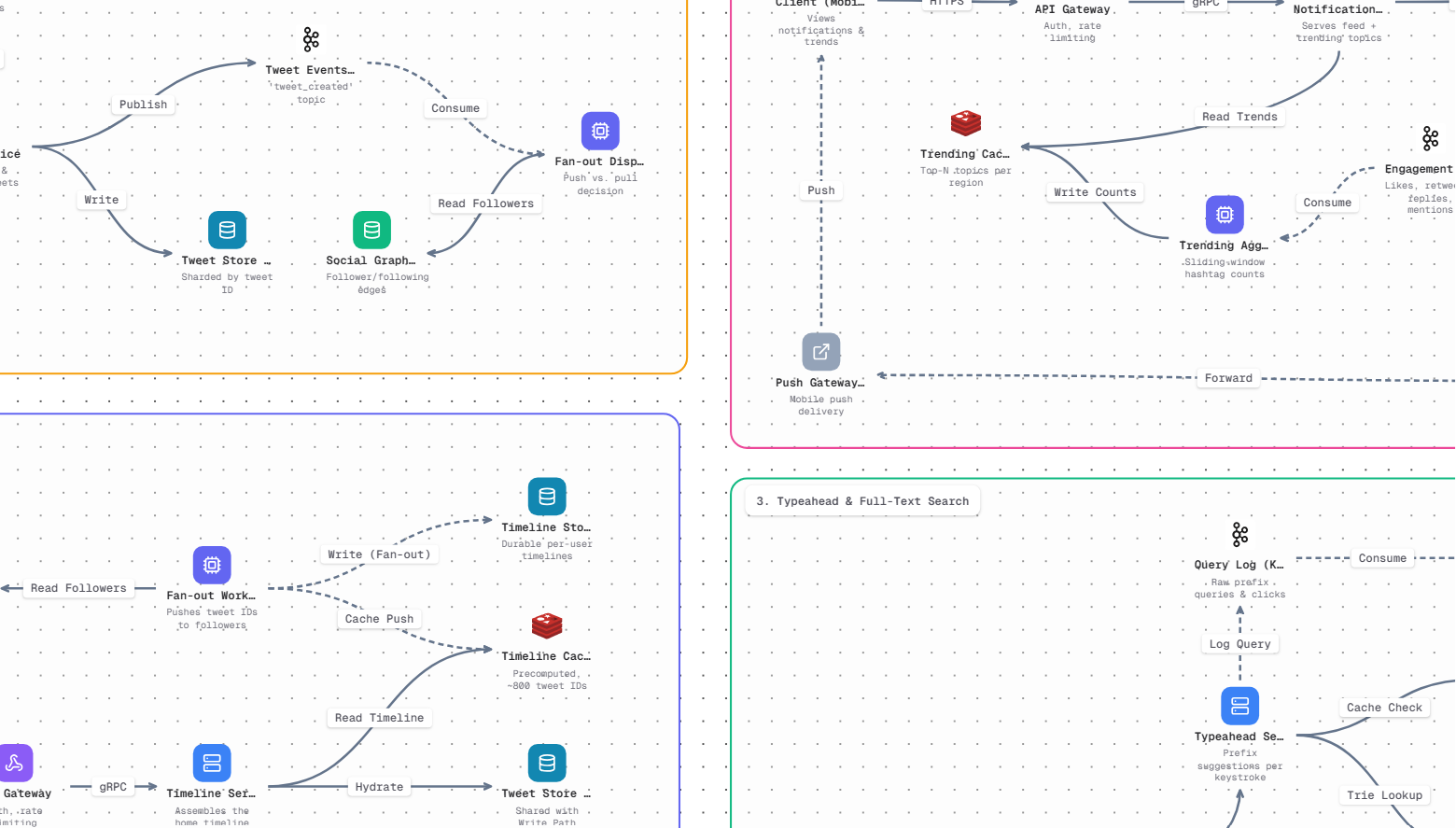
Design Twitter for Millions of Users
A microblogging platform with tweet ingestion, hybrid fan-out timelines, typeahead search, and real-time notifications.


A system that returns the top-K ranked prefix completions as a user types, serving results within the keystroke latency budget through precomputed in-memory trie lookups.
Rough, order-of-magnitude numbers. The point is to justify the architecture, not to be exact.
A diagram shows what exists; a trace shows what happens. Press play on a flow, or click any step, and the diagram above lights up the exact path that request takes.
A user types in the search box — the system returns the top-K completions within the keystroke latency budget.
Events from user searches flow through the offline pipeline, producing a fresh ranked trie that is atomically deployed to the serving tier.
Every box on the canvas, and the job it does. Click a card to locate it in the diagram; click the node itself for the full deep dive.
The Typeahead Suggestion system is split into two decoupled paths: a hot read path that serves ranked prefix completions from memory within the keystroke latency budget, and an offline build path that ingests events, computes popularity, and constructs fresh ranked tries.
Each keystroke fires a debounced GET /v1/suggest request. The call flows through the CDN, Load Balancer, and API Gateway to the Suggest Service. The Suggest Service first checks Redis for the precomputed top-K completions of the typed prefix — on cache hit, results return in under a millisecond. On cache miss, the service routes to the appropriate Trie Shard via prefix-based routing. The shard holds a radix-compressed trie where every node stores its own precomputed top-K list, so a lookup is a pointer walk to the prefix node and a memory read of the cached results — no ranking, no sort, no disk. The entire round trip completes within the per-keystroke budget.
The Suggest Service asynchronously publishes search and click events to Kafka. The Aggregator Service consumes event batches on a 15-minute schedule, computing per-query popularity scores with recency decay so stale fads fade and rising queries gain rank. Aggregated scores are written to Cassandra. The Trie Builder periodically reads the full popularity table and constructs a fresh radix-compressed ranked trie using bottom-up top-K propagation — each node's top-K is a merge of its children's precomputed lists, never a subtree scan. The completed immutable trie is deployed to every shard via an atomic pointer swap: all shards atomically switch to the new version without locking, while reads in flight finish on the old trie.
Rank offline, serve from memory. Precomputing the ranked top-K for every prefix is what makes the per-keystroke latency budget attainable. The decision to rank when data changes (offline) rather than when it is read is the central design principle that shapes everything else.
Immutable trie with atomic swap. The trie is rebuilt entirely off the serving path and swapped in as a single atomic operation. This eliminates read-write contention, keeps the read path lock-free, and provides natural crash isolation — a failed build simply leaves the old trie in place.
Prefix-based sharding with skew awareness. The trie is split by leading characters so each request touches exactly one shard. Hot prefix ranges are sub-sharded further to prevent skew from overwhelming a single node, while cold ranges share a shard efficiently.
An architecture is a record of trade-offs. For every major choice here: what won, what lost, and why the constraints made it so.
Ranking at query time fails the latency budget as the corpus grows — a short prefix like c could match millions of queries, and sorting them per keystroke is O(N log N) over a growing corpus with a fixed time budget. By precomputing the ranked top-K for every prefix during the offline build, the hot path becomes O(prefix length) — a pointer walk and a memory read. The trade-off is rebuild-cycle staleness, but popularity shifts over minutes to hours while reads arrive constantly.
A database WHERE query LIKE 'prefix%' ORDER BY score LIMIT 10 requires a full index scan or a prefix scan plus a sort per query — unacceptably slow at 500K QPS. Elasticsearch adds network overhead and per-query scoring. A radix-compressed trie held in RAM eliminates disk and network I/O: lookup costs one pointer walk per character and returns a pre-sorted list. The 12 GB estimate confirms the trie fits comfortably on a single serving host, and radix compression shrinks it further.
Incremental updates require mutable shared state and write locks on the trie — they introduce contention on the read path and risk readers seeing half-applied updates. A batch rebuild produces a complete, immutable, internally consistent trie that is swapped in atomically. The 1-hour rebuild interval is acceptable because popularity changes slowly. When trending matters, a small real-time layer blends in recent top queries without touching the heavy trie.
Consistent hashing scatters a prefix's completions across multiple shards, requiring a read to query all shards and merge results — O(N shards) per lookup. Prefix-range sharding ensures every prefix lives on exactly one shard: one lookup, one response. Skew-aware sub-sharding splits hot ranges (e.g. s*) across more shards than cold ranges (z*), keeping load balanced without scatter-gather.
In-place mutation requires every read to acquire a lock or risk seeing a partially updated structure. Readers in a concurrent 500K QPS system contend destructively. An immutable trie built off the serving path and exposed via a single atomic pointer swap eliminates all synchronization: readers see a consistent snapshot without ever taking a lock. The old trie is garbage-collected once all in-flight reads referencing it complete.
Reading a system means sensing where it cracks under 10× load. These are the pressure points of this design, and how it holds.
Short prefixes like a, s, or th receive a disproportionate share of suggest traffic because they match enormous numbers of completions and are typed by nearly every user. A single shard holding these ranges can be overloaded while other shards sit idle.
The routing layer supports skew-aware sub-sharding: hot ranges are split across multiple shards (e.g. s-a through s-m on one shard, s-n through s-z on another). The boundary table is updated during each rebuild cycle based on observed traffic patterns.
When a fresh trie is deployed, the Redis cache contains entries built from the old trie's data. If the old and new rankings differ significantly, the first wave of requests after the swap all miss Redis simultaneously and hit the trie shards in a thundering herd.
Cache TTLs are set to a fraction of the rebuild interval (e.g. 15 minutes) so the cache drains gradually rather than all at once. Additionally, the Suggest Service can pre-warm Redis with the new trie's top prefixes before the swap completes.
A query that begins surging minutes after a rebuild finishes will not appear in suggestions until the next build up to an hour later. For rapidly developing events (breaking news, viral moments), hour-old rankings feel noticeably stale.
A lightweight real-time layer blends in: a small in-memory structure tracks recently popular queries over a short sliding window. At query time, the Suggest Service merges the precomputed top-K with the real-time list — both K-length — re-sorts, and keeps the top K. This adds a handful of comparisons per request, not a full ranking.
The Trie Builder reads the entire Cassandra popularity table and constructs a multi-gigabyte trie in memory. During this window, the builder competes for Cassandra read capacity and network bandwidth with other consumers. A naive implementation can degrade the aggregator's write throughput.
The builder runs on dedicated hosts and throttles its Cassandra read rate to leave headroom for concurrent writes. The build itself is stateless and resumable — if it is interrupted, the old trie continues serving and the builder retries on the next scheduled interval.
If you can answer these without scrolling back up, the architecture is yours. Try each one out loud before revealing.
Every great system starts as a sketch on a whiteboard. The ability to zoom out and see the whole picture (how services connect, where data flows, what breaks and why) is what separates engineers who build features from engineers who build systems. This diagram is more than boxes and arrows. It's a map of decisions, trade-offs, and intentional design.
Studying architectures isn't just about passing interviews. It's about training your intuition. The more systems you take apart, the better you get at sensing where a monolith will crack, where a queue belongs, or when a cache is hiding a deeper problem. You start seeing patterns instead of chaos.
So keep reading, keep tracing those edges, keep asking "why this way and not that way." The engineers who truly understand large systems are the ones who never stop being curious about how things fit together. That curiosity is the only ingredient that really matters.
Atharva Arbat@arbat_atharva
A microblogging platform with tweet ingestion, hybrid fan-out timelines, typeahead search, and real-time notifications.
A scalable, highly available cloud file storage and synchronization service.
Cloud-native e-commerce platform on AWS